What GOTS and OEKO-TEX actually mean on a rug label
Two labels turn up on almost every rug now sold as healthy, natural or safe for children: GOTS and OEKO-TEX. They are printed side by side, in the same weight of type, as though they were interchangeable proofs of the same thing. They are not. One tests what is in the finished product. The other governs how the fibre was grown and processed. A rug can carry either, both, or — most commonly — a vague claim to be "certified" with nothing behind it at all.
For a rug this matters more than for a shirt. A child on the floor spends hours with their face in the pile, breathing the air closest to it. Whatever the fibre releases, they get first and they get most. So it is worth knowing precisely what each label does and does not promise.
OEKO-TEX STANDARD 100: what is in the finished product
STANDARD 100 is a chemical safety test. Every component of an article — every thread, every button, every accessory — is tested against a list of more than a thousand harmful substances, and the limit values are reviewed at least once a year. The list aligns with the restricted-substance annexes of the European REACH regulation, the American CPSIA, and the ECHA candidate list of substances of very high concern.
The standard has four product classes, graded by how much skin contact the article has. Class I is the strictest and covers articles for babies and toddlers up to three years old. Class II covers items with direct skin contact such as bed linen, Class III items without direct contact, and Class IV decoration textiles such as curtains.
That last class is where the catch sits. Rugs are frequently certified under Class IV, the least demanding tier, because a rug is formally a decoration textile. For an object a baby lies on, Class IV is the wrong reference. If a rug is being sold for a nursery, the class worth asking about is Class I.
OEKO-TEX tells you what is not in the rug. It tells you nothing about where the fibre came from.
What OEKO-TEX does not cover
This is the part most product pages leave out. STANDARD 100 tests chemical residue in the finished article. It does not certify that a fibre is organic, it says nothing about how the sheep were kept or the land was farmed, and it does not address working conditions in the supply chain. A wholly synthetic polyester rug can hold a valid STANDARD 100 certificate. That certificate is meaningful — it means the article tested clean against a serious list — but it is not an organic claim, and a seller who presents it as one is either confused or counting on you being.
GOTS: how the fibre was grown and processed
The Global Organic Textile Standard works from the other direction. It sets a minimum proportion of certified organic fibre a textile must contain to carry the label, and then governs everything downstream: which dyes and processing inputs are permitted, wastewater treatment, and social criteria for the people doing the work. It is a supply-chain standard, not only a product test.
GOTS operates two label grades. The higher one is for textiles made predominantly of certified organic fibre; the lower grade allows a smaller organic proportion, with strict limits on what the remainder may be. The exact percentages are set by the current version of the standard, which is revised periodically — worth checking against the standard in force rather than against a blog post, this one included.
One nuance is regularly misread: GOTS does not itself define how organic fibre is farmed. It recognises established organic farming standards and takes over from the point the fibre enters processing. So a GOTS label is a statement about the whole chain from raw fibre to finished textile, resting on a separate agricultural certification underneath it.
Wool, specifically
Both standards apply to wool, and for a wool rug the combination is genuinely informative. GOTS speaks to how the wool was produced and processed; OEKO-TEX speaks to what survived into the object in your room. Neither, on its own, is a complete answer.
The treatments worth asking about specifically are the ones conventionally applied to rug wool and rarely mentioned in a product description: synthetic mothproofing, PFAS-based stain repellents, and latex or glued backings. A certificate under either standard constrains these, but the fastest way to find out is to ask the question directly and see whether you get a straight answer.
The questions worth asking
A certification is only as good as the document behind it. Certificates are issued with a number, an issuing institute, a validity period and a defined scope — which article, which components. A seller who holds one can produce it in a sentence. Five questions are usually enough:
Which standard, and what is the certificate number? Which product class, for OEKO-TEX? Does the certificate cover the whole rug, including the backing and the fringes? Has the wool been mothproofed or treated for stains? And what, exactly, is the backing made of?
Vagueness in the answers is itself the answer. "Certified organic" with no issuing body, no number and no scope is a marketing phrase, not a certification.
Where we stand
We do not hold a GOTS or OEKO-TEX certificate. We could let you assume our wool is certified; it is not, and we would rather you heard that from us than found it out later.
A certificate also costs money — every year, at every link in the chain. That is one reason the large producers have one and the small ateliers rarely do. It does not make certificates worthless: they are worth exactly what they verify. It means that finding one does not prove quality, and not having one does not prove the opposite.
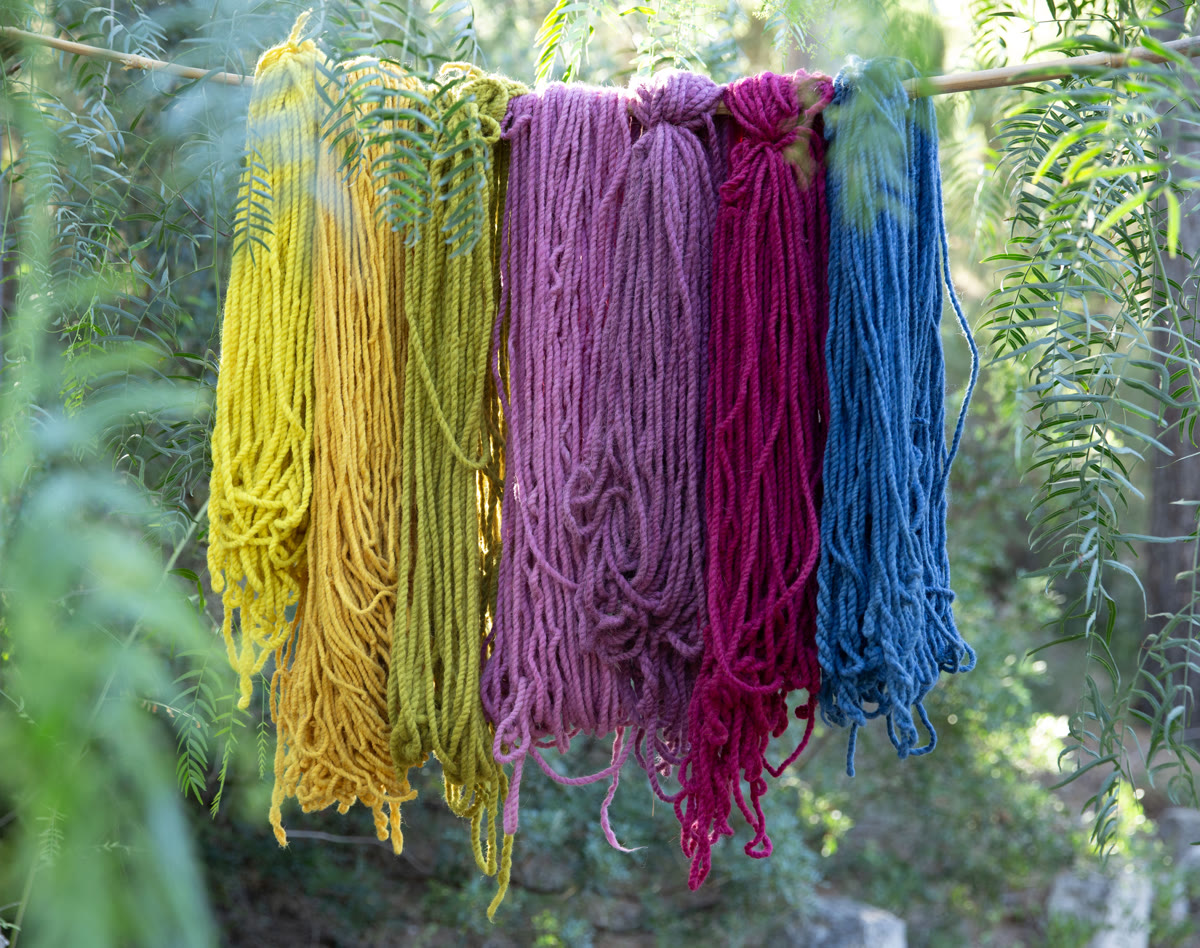
What we have instead is the chain itself. We shear the sheep ourselves, so we know exactly what we are buying. The wool is washed with a soap we make from olive oil and soda — two ingredients. The colours come from plants we harvest around the atelier and prepare ourselves, with one exception we buy ready: cochineal. A certificate attests that a third party checked a supplier. We have no supplier to check. Ask us about any step and you will get a straight answer, which is more than a certificate number will ever give you.
FAQ
Is OEKO-TEX the same as organic?
No. OEKO-TEX STANDARD 100 is a chemical safety test on the finished article: it verifies that the product tested clean against a list of more than a thousand harmful substances. It makes no statement about whether the fibre is organic, how it was farmed, or under what conditions it was made. A fully synthetic rug can hold a valid STANDARD 100 certificate.
Which OEKO-TEX product class should a child’s rug have?
Class I, which covers articles for babies and toddlers up to three years old and carries the strictest limit values. Rugs are often certified under Class IV, the decoration-textile class, which is the least demanding. If a rug is sold for a nursery, ask specifically which class the certificate covers.
Does GOTS certification apply to wool rugs?
Yes. GOTS covers organic fibre including wool, and governs processing, dyes, wastewater and social criteria through the supply chain. Note that GOTS does not itself define the agricultural standard for growing or raising the fibre — it recognises established organic farming standards and takes over from processing onwards.
A seller says their rug is "certified organic" but gives no number. Is that enough?
No. Every genuine certificate has an issuing institute, a certificate number, a validity period and a defined scope stating which article and which components are covered. A seller holding one can give you those details immediately. A claim with none of them attached is a marketing phrase.
Our pieces are made from natural wool and coloured with plants we harvest ourselves. No certificate — the whole chain instead, and a straight answer to any question.
See the collection